3月 . 29, 2024 17:59 Back to list

What are Carbon Filters for Water Filtration?

What are Carbon Filters Used For?

A carbon water filter is commonly used in water filtration systems--whether it's a backpacking water filter, refrigerator filter, shower filter, pitcher filter, or RO drinking water system. Because carbon is an extremely effective medium when filtering contaminants from water, all of the above-mentioned filtration scenarios utilize carbon in the water filtration process.


Raw coal crushed activated carbon

 
Carbon filters for water filtration are produced by grinding up a carbon source.

This carbon source could be:

    • bituminous coal
    • peat
    • coconut shells

Of the above-mentioned carbon sources, coconut shells are the most widely used and are highly renewable.

To create the filter, material is heated in the absence of oxygen to 1000 degrees to bake off impurities. The material is then subjected to 1600-degree steam to “activate” the carbon. The steam leaves carbon granules filled with cracks and pores, enabling them to store large amounts of chemicals and contaminants.


How do Carbon Filters Work?


Carbon filters remove contaminants through adsorption. Adsorption means that contaminants are attracted to the surface of the activated carbon and held to it, much the same way a magnet attracts and holds iron filings.

Carbon filters also act as a catalyst to change the chemical composition of some contaminants. Activated carbon is ideal for removing chlorine, organic chemicals such as pesticides, THMs like chloroform, and many VOCs (Volatile Organic Chemicals) that are components of gasoline, solvents and industrial cleaners.


What is a Granular Activated Carbon (GAC) Water Filter?

GAC stands for "granular activated carbon" and is made of tiny, loose granules of carbon. GAC filters are usually used as a "polishing filter' in the water filtration process and are highly effective at improving the taste and odor of drinking water.

While a GAC carbon filter is simply loose pieces of carbon, a carbon block filter is where the loose pieces of carbon are compressed together to form a filter.


What do GAC Water Filters Remove?

Granular activated carbon (otherwise known as GAC) filters have extremely high adsorption capabilities and can remove a wide variety of contaminants (see contaminant list here).

GAC filters are often used to remove VOCs, pesticides, nitrates, hydrogen sulfide, and much more.

Municipal water treatment plants use disinfectants such as chlorine and chloramine which can leave an objectional taste and odor in drinking water. GAC filters are able improve taste and odor and are therefore commonly used as one or two stages in a reverse osmosis system.


What is a Carbon Block Filter?

A carbon block filter is where the loose pieces of carbon are compressed together to form a filter.

In a carbon block filter, one pound of compressed activated carbon (the amount in a standard ten-inch filter cartridge) has the equivalent surface area of a 160 acre farm, making it one of the most absorbent materials known to man.

Because of the compressed nature of a carbon block filter, water flow rates are lower than that of a GAC filter made of loose medium. And flow rates are impacted by the micron rating of the filter. A carbon block filter is rated to a certain micron rating depending on how much the carbon is compressed. The smaller the micron rating, the finer the filtration and the lower the flow rate.


GAC vs. Carbon Block Filters

  GAC (Granular Activated Carbon) Carbon Block

Appearance

Carbon filters can be made from granually activated carbon
inside a carbon filter
Medium Type
Loose carbon granules
Compressed carbon
Filtration Purpose
Prefilter & Polishing filter
Prefilter
Typical Use
To improve taste and odor of water by removing chlorine, hydrogen sulfide (rotten egg odor), etc. See complete list here.
Can filter sediment, as well as pesticides, heavy metals, and other contaminants
Flow Rates
Generally higher flow rates
Generally lower flow rates
How Often to Replace
Every 6-12 months*
Every 6-12 months*
Advantages
May do a better job at adsorbing certain contaminants
Can adsorb AND filter
 

Carbon Block Filters vs. Granulated Carbon Filters

What is the difference between a carbon block filter and a GAC filter? Carbon block filters and GAC filters are made of the same material, but one is made of ground up loose carbon and the other is the loose carbon that has been compressed.

Many water filter systems use both carbon block AND GAC filters in the water filtration process.

Carbon block filters are made of a solid block of compressed carbon and are often used as a pre-filter in reverse osmosis and other water filtration systems. Carbon block water filters are extremely effective in filtering out a variety of contaminants including very small contaminants or particle size. Water will often flow slower during this filtration stage due to the compact nature of the compressed carbon.

The granular activated carbon or GAC water filter is made of loose carbon granules. Water flows more freely through this stage, so flow rates are higher for GAC filters than carbon block filters. GAC filters also have very high adsorption properties and can remove contaminants including chlorine, hydrogen sulfide, lead and much more.


Carbon Block Filters are Rated in Microns

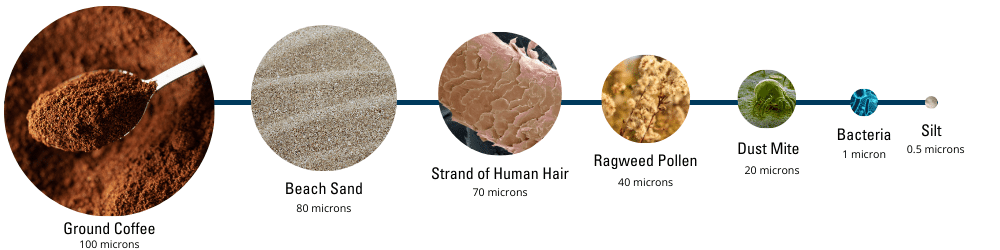
Carbon block filters are rated by the size of contaminants that can be removed at the micron level. Generally, the range is from 50 microns down to .5 microns. The higher the rating, the larger the contaminant size. Very small contaminants will need to be filtered with a small micron size rated filter, such as .5-micron rating.

micron filter size for understanding water filter micron rating


Reverse Osmosis Filter Change Schedule


Sediment Filter

Carbon Filter

RO Membrane

GAC Polishing
Change out every 6-12 months

Change out every 6-12 months

Change out every 24 months

Change out every 6-12 months

*Filter change schedule may vary based on local water conditions and household usage


How Often Should Carbon Filters Be Changed?

For carbon filters used in reverse osmosis drinking water systems, both the carbon filter and the polishing filter (granular activated carbon filter) should be replaced every 6-12 months. Ultimately, the lifespan of a carbon filter can vary based on how dirty or contaminated the water is. Carbon quality, humidity and usage can also factor into how long a carbon filter can last.

Share

Latest news
If you are interested in our products, you can choose to leave your information here, and we will be in touch with you shortly.

Chatting

zh_CNChina